ScientificInstrumentation
Custom scientific instruments designed by engineers who understand the science.
Trusted by leading scientific companies





Instrumentation projects we've delivered
Custom instruments and measurement systems taken from concept to production.
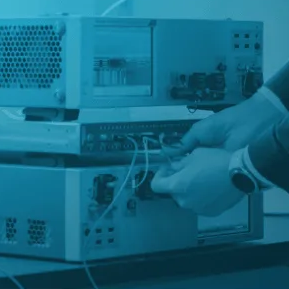
Quantifi Photonics
Precision hardware for Quantifi's photonics test and measurement products. High-speed analogue control loops, laser diode drivers, and milli-kelvin temperature control.

Milk Testing System
Instrumentation built with Fonterra to measure specific aspects of milk powder quality, combining mechanical design, imaging, and processing software.
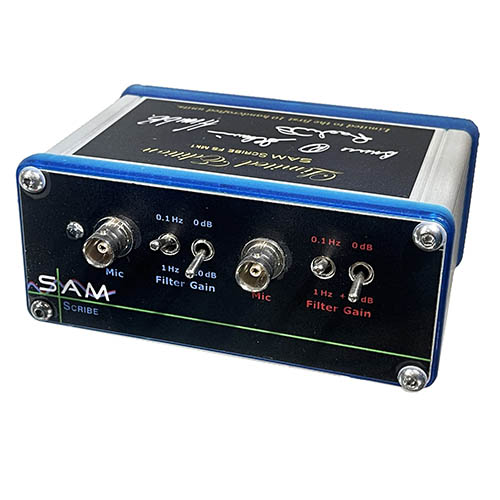
SAM Scribe Acoustic Recorder
Dual-channel broad-spectrum USB sound recorder for Atkinson & Rapley's SAM Scribe, with a sub-0dB SPL noise floor for investigating industrial noise pollution.
Need a custom instrument
designed?
Delivered by New Zealand's leading electronic product design team.
I need a custom instrumentWhat we build
From single-channel sensor interfaces to multi-instrument measurement systems. Precision electronics for demanding applications.
Custom Sensor Interfaces
Precision analog front-ends for photodetectors, strain gauges, thermocouples, and electrochemical sensors. Low-noise design with sub-microvolt resolution.
Data Acquisition Systems
Multi-channel, high-resolution ADC systems with precise timing. Synchronous sampling, triggering, and real-time data streaming.
Signal Conditioning
Amplification, filtering, and isolation circuits for demanding measurement environments. EMI hardening and ground-loop elimination.
Precision Timing & Control
Nanosecond-resolution timing for pulsed measurements, laser control, and synchronised multi-instrument systems.
Instrument Control Software
Desktop and embedded control applications. Data visualisation, experiment automation, and instrument calibration routines.
Optical & Spectroscopy Systems
Detector electronics, laser drivers, spectrometer interfaces, and photon counting systems for optical measurement applications.
Mixed-Signal PCB Design
Careful partitioning of analog and digital domains. Controlled impedance, low-noise power delivery, and precision reference design.
Calibration & Compliance
Traceable calibration procedures, measurement uncertainty analysis, and support for IEC/ISO laboratory standards.
Enclosure & Thermal Design
IP-rated enclosures, thermal management for precision electronics, and ruggedised housings for field deployment.
Scientific instrumentation questions
Common questions about cost, timelines, precision, sensors, and industries for custom scientific instrument projects.
How much does a scientific instrumentation project cost?
Scientific instrumentation projects sit in the five to six-figure range. The exact number depends on channel count, required precision and noise floor, custom analog or FPGA processing, regulatory targets, and whether traceable calibration is required. Most custom scientific instrument development requires a five or six-figure investment. Every project is different. The right scope is set after a short discovery conversation. Get in touch and we'll give you a tailored estimate.
How long does scientific instrument development take from concept to working prototype?
Timelines depend on channel count, required resolution and noise floor, regulatory targets, and whether traceable calibration is required. Most scientific instrument projects take 9 to 15 months from concept to working prototype. A straightforward data acquisition instrument can prototype faster. A precision optical, spectroscopy, or multi-modality instrument with custom analog front-ends, FPGA processing, and calibration routines takes longer. Get in touch for a tailored timeline after a short discovery conversation.
What sensors and measurement modalities can you integrate into an instrument?
We integrate thermocouples, RTDs, thermistors, strain gauges, load cells, photodiodes, PMTs, APDs, pressure transducers, mass flow sensors, electrochemical and pH probes, ultrasonic transducers, optical spectrometers, laser diodes, and custom MEMS or piezo elements. On the digital side, most protocols can be implemented. Common ones we have used are SPI, I2C, UART, CAN, RS-485, USB, and Ethernet-based sensors. Every integration includes signal conditioning, filtering, isolation where needed, and calibration hooks in firmware. The sensor reading is traceable to engineering units.
What industries and applications do you design scientific instruments for?
We design instruments for agritech, life sciences, environmental monitoring, food and dairy (with partners like Fonterra), aviation, academic research labs, and industrial process measurement. Applications include milk composition analysis, soil and water sensing, laboratory test and measurement equipment, calibration reference instruments, temperature microscopy stages, precision linear positioning, nuclear magnetic resonance (NMR) instruments, precision brushless motor control, high-speed >1 GHz custom acquisition systems, and precision field instruments for outdoor deployment. With 1,100+ projects delivered over 18+ years, we have the domain breadth to match instrument architecture to the measurement problem.
“It is rare to find the combination of high-technology technical expertise, practical hands-on skills with sophisticated and friendly customer service... Beta Solutions have such a comprehensive team to focus on each project.”Bruce RapleyAtkinson & Rapley Consulting
Want us to handle the whole product?
Scientific instrumentation is just one piece. If you don't want the headache of managing hardware, firmware, mechanical, and manufacturing separately, we handle the entire product development under one roof.
Other ways we can help
Scientific instrumentation is just one part of what we do. Explore our other services.
FPGA & Signal Processing
Real-time data processing, DSP algorithms, and high-speed acquisition.
PCB Design
High-speed digital, RF, power electronics, and mixed-signal. Custom boards from schematic to production-ready files.
Firmware/Software Design
Bare-metal and RTOS firmware. We write the code that runs on the boards we design.
Mechanical Design
Enclosures, mounts, and housings designed around the electronics, not retrofitted after.