
This article examines Sigfox technology, a Low Power Wide Area Network (LPWAN) protocol designed for transmitting modest data volumes across considerable distances. Compared to conventional cellular networks, LPWAN devices consume far less power, potentially operating for 5-10 years on a single battery charge.
While major telecommunications companies like Spark and Vodafone are developing competing LPWAN solutions expected to launch between 2018-2019, Sigfox achieved 50% coverage of New Zealand in August 2016.
General Overview
Founded in 2009, Sigfox is a French company creating an end-to-end LPWAN solution specifically designed for Internet-of-Things applications. The technology suits applications requiring:
- Low manufacturing costs
- Infrequent transmission of minimal data
- One-way communication (device-to-base station only)
- Non-critical information transmission
Temperature sensors exemplify ideal Sigfox applications. However, devices needing high data volumes, two-way communication, or downlink messaging should consider alternative technologies.
Key limitations:
- 12-byte payload maximum
- Very limited two-way communication capabilities
Technical Overview
Network Architecture
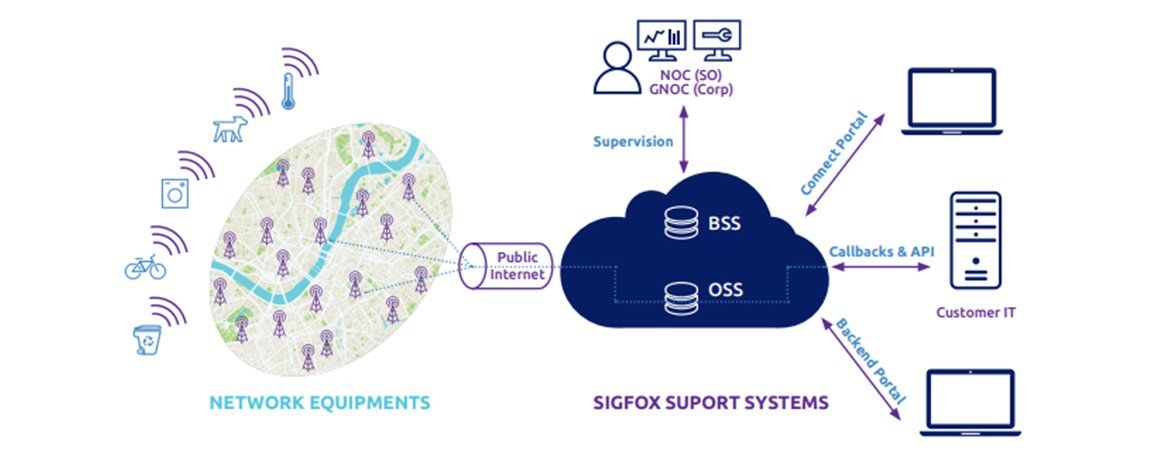
Sigfox employs a horizontal, two-layer architecture:
1. Equipment Layer
The infrastructure consists primarily of base stations receiving device messages and forwarding data to support systems. New Zealand's Sigfox base stations are built by Kordia and operated by Thinxtra.
2. Support System Layer
Backend software processes device data, displaying information through web interfaces. Users can configure "callbacks" to route messages to cloud platforms of their choice.
Security Features
Data protection:
The network architecture provides inherent security advantages over typical cellular systems. Devices never establish persistent internet connections, only transmitting when programmed. This creates what Sigfox terms a "built-in firewall." Messages use default encryption, though the network provider can view payload information. Users requiring enhanced privacy can implement additional device-side encryption.
Device authentication:
Manufacturers assign authentication keys during production. Each transmitted message includes a cryptographic token derived from this key, validated by backend systems to confirm device identity and prevent impersonation attacks.
Network Coverage
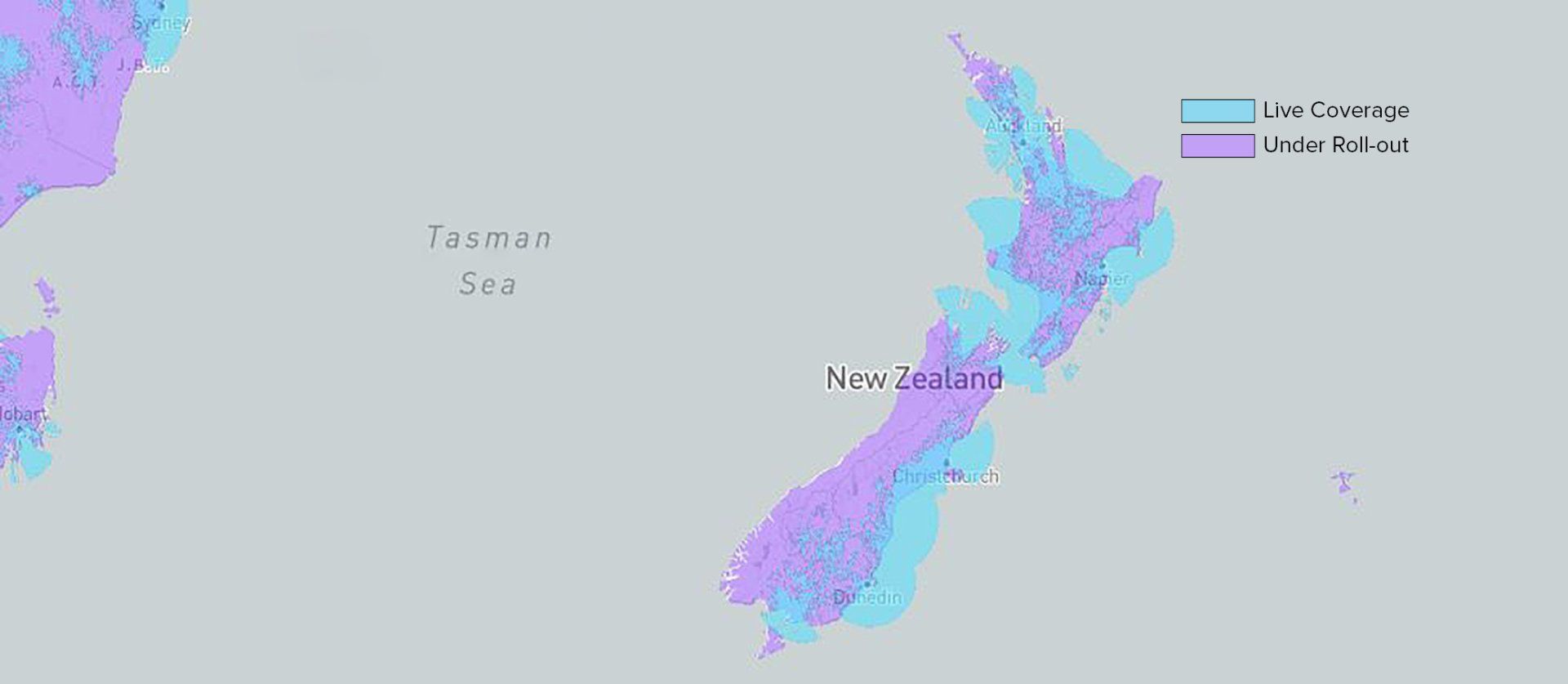
As of February 2018, Thinxtra achieved 85% of New Zealand's population coverage, primarily in urban centers. This represents a significant advantage over competing LPWAN technologies not yet officially deployed.
Coverage extensions:
Users without adequate coverage can rent mini base stations that extend network reach. For customers with extensive device deployments, Thinxtra may install full base stations at no charge.
Technical Implementation: Range and Power Efficiency
Sigfox achieves extended range and low power consumption through:
Frequency selection:
Operating below 1GHz, signals penetrate the atmosphere more effectively, increasing transmission range.
Ultra-narrow band modulation:
Sigfox transmits across a 192kHz band using ultra-narrow band (UNB) modulation. Individual messages occupy only 100Hz, enabling spectrum efficiency while helping base stations distinguish signals from background noise.
Random access protocol:
Since continuous device-to-base station connections would consume excessive power, Sigfox devices communicate asynchronously. To improve message reception reliability, each transmission automatically sends three identical copies across different frequencies within the 192kHz bandwidth.
Spectrum usage:
Sigfox operates at 928MHz unlicensed spectrum in New Zealand, avoiding licensing costs. Technical regulations limit "on-air" time to 1% to prevent interference.
Operational Constraints
Sigfox enforces uniform global rules:
- 140 maximum uplink messages daily (device-to-base)
- 12-byte uplink payloads
- 4 maximum downlink messages daily (base-to-device)
- 8-byte downlink payloads
- 600 bps transmission at 24 dBm in New Zealand
Uplink messages carry collected data to cloud backends. Each 12-byte payload requires six seconds for transmission, yielding 2 bytes per second effective throughput, over 2 million times slower than 4G cellular, but consuming proportionally less energy.
Downlink messaging primarily serves configuration purposes, with reception quality suffering from low-grade device receivers compared to cellular-grade base station equipment.
Comparison with Competing Technologies
Versus LoRa:
- LoRa allows users to establish independent gateways and operate networks without fees, or subscribe to paid networks
- Sigfox provides exclusively through Thinxtra with no user control
- This dependency carries risks should the operator fail
Versus NB-IoT:
- NB-IoT achieves 20-60 kbps transmission speeds, enabling over-the-air firmware updates
- Sigfox's 0.6 kbps speed prevents OTA updating
Sigfox advantages:
- Supports roaming between base stations (LoRa also supports this; NB-IoT struggles)
- Offers the lowest device costs, a critical factor for large-scale deployments
- Provides royalty-free protocol stack access to module manufacturers, reducing device expenses to approximately one-quarter of competing technologies' costs
Sigfox disadvantages:
- Small payload constraints
- Limited daily message allowances
- Restricted two-way communication capabilities
Conclusion
No universal LPWAN solution exists; each technology presents distinct tradeoffs. Sigfox distinguishes itself through affordable devices enabled by its royalty-free protocol stack and established coverage exceeding 85% of New Zealand's population. However, restricted payload sizes, limited daily messages, and two-way communication limitations may prove prohibitive for certain applications.
Beta Solutions has experience implementing multiple IoT connectivity technologies including LoRaWAN, Sigfox, Cellular, Bluetooth, WiFi, and Satellite communication.
References
- Sigfox Network Architecture. Retrieved from https://www.disk91.com/wp-content/uploads/2017/05/4967675830228422064.pdf
- Sigfox Coverage of New Zealand. Retrieved from https://www.sigfox.com/en/coverage
- Photographs from Pexels https://www.pexels.com