By 2030, projections indicate 130 billion devices will connect to the internet, creating what's known as the Internet of Things (IoT). Low Power Wide Area Networks (LPWAN) represent an emerging communications technology poised to enable this massive scale of connectivity.
Communications Technologies Defined
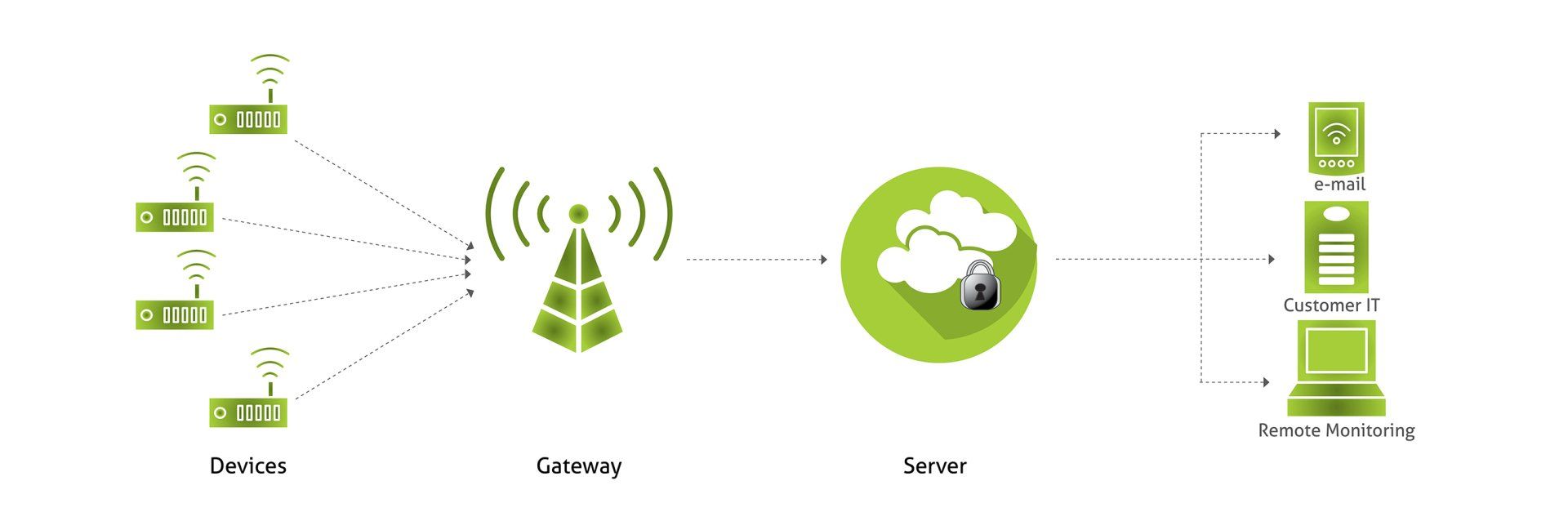
Connecting devices to the internet requires electronic signals transmitted between a Device and a Server in a mutually understood format. This combination of hardware and software must work through intermediary hardware called "Gateways," which act as the middleman between servers and devices. Multiple devices can connect to the same gateway.
Communications technologies encompass both hardware and software controlling information flow. Existing wireless technologies include Cellular, Satellite, Bluetooth, WiFi, Zwave, and Zigbee.
What is LPWAN?
LPWAN stands for "Low Power Wide Area Network." The terminology breaks into two components:
- Low-Power, enables devices to operate from small batteries lasting 5-10 years
- Wide-Area-Network, communicates over long distances (approximately 2-20 km+)
While low-power technologies and long-range technologies exist separately, LPWAN uniquely combines both properties. However, this requires a significant trade-off: LPWAN can only transmit very small amounts of data.
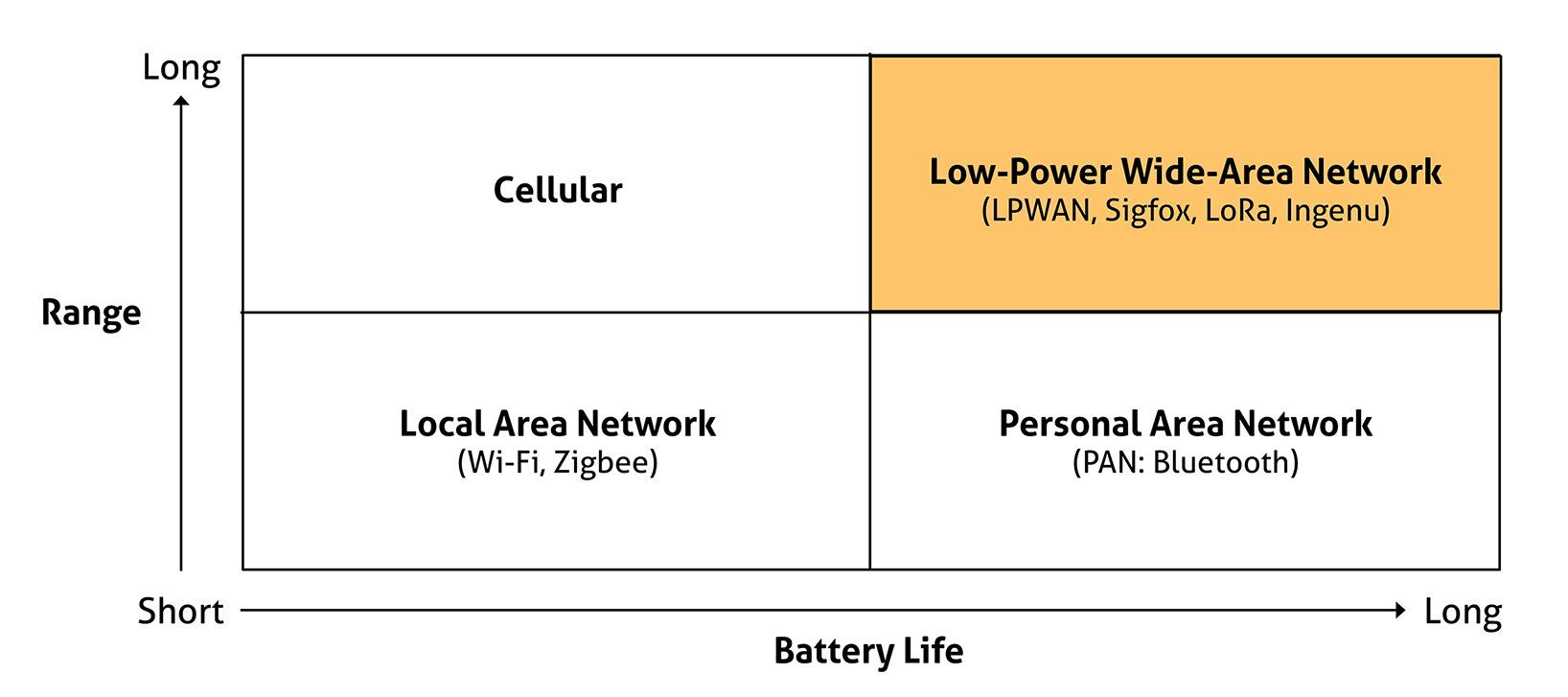
This limitation suits applications requiring low data rates. For instance, water tanks don't require continuous level updates if levels haven't changed. Specific LPWAN technologies include LoRa, Sigfox, and Weightless-N.
Benefits of LPWAN
Low Power Usage
Devices consuming minimal power can expect battery lifespans of 5-10 years. The microprocessor enters sleep mode when inactive, drawing negligible current.
Low Cost and Long-Lasting Batteries
Low overall power requirements enable cost-effective battery utilization. Additionally, LPWAN's relatively modest peak power demands allow cheaper battery technologies compared to traditional cellular modems.
Long Distance Communications
LPWAN achieves 3-20 km communication ranges. Urban areas typically reach 2-5 km due to building obstruction and interference, while rural environments with clear line-of-sight may achieve 15-30 km. The LoRa distance record stands at 702 km from a weather balloon.
Low Number of Gateways
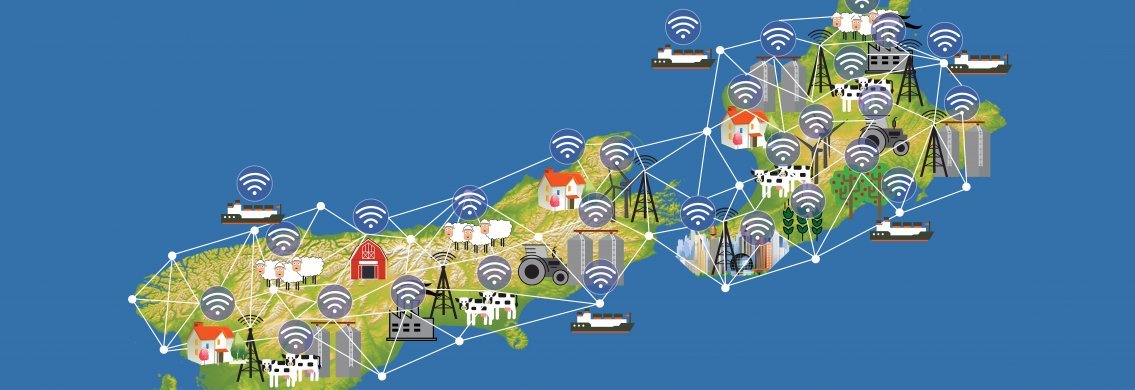
Extended communication range reduces required gateway infrastructure. Amsterdam operates effectively with approximately 24 gateways despite dense urban construction. Rural environments like New Zealand farms could potentially share gateways across 15 km coverage areas.
Free Radio Spectrum
LPWAN operates on unlicensed spectrum, eliminating licensing fees and enabling anyone to become a gateway provider with potentially zero data costs. However, this openness risks network congestion from competing devices on identical frequencies.
How Does it Work?
Achieving Long Range
Most LPWAN technologies use narrow bandwidth transmissions; some (like LoRa) employ advanced signal processing. The fundamental principle: slower transmission enables longer range.
Sigfox illustrates this: transmitting 12-byte data packets takes approximately 2 seconds at roughly 100 bits per second. Conversely, 3G cellular modems transmit identical packets in fractions of a second at 10,000,000+ bits per second.
Achieving Low Power
LPWAN systems only allow devices, not servers, to initiate communication. Devices might transmit 100 times daily or once daily but cannot respond to server-initiated requests. This eliminates continuous power consumption from listening for incoming server communications. Gateways, typically grid-powered, continuously listen for device transmissions without power constraints.
This differs fundamentally from traditional cellular technology, which requires continuous device connectivity for both sending and receiving data.
Topology
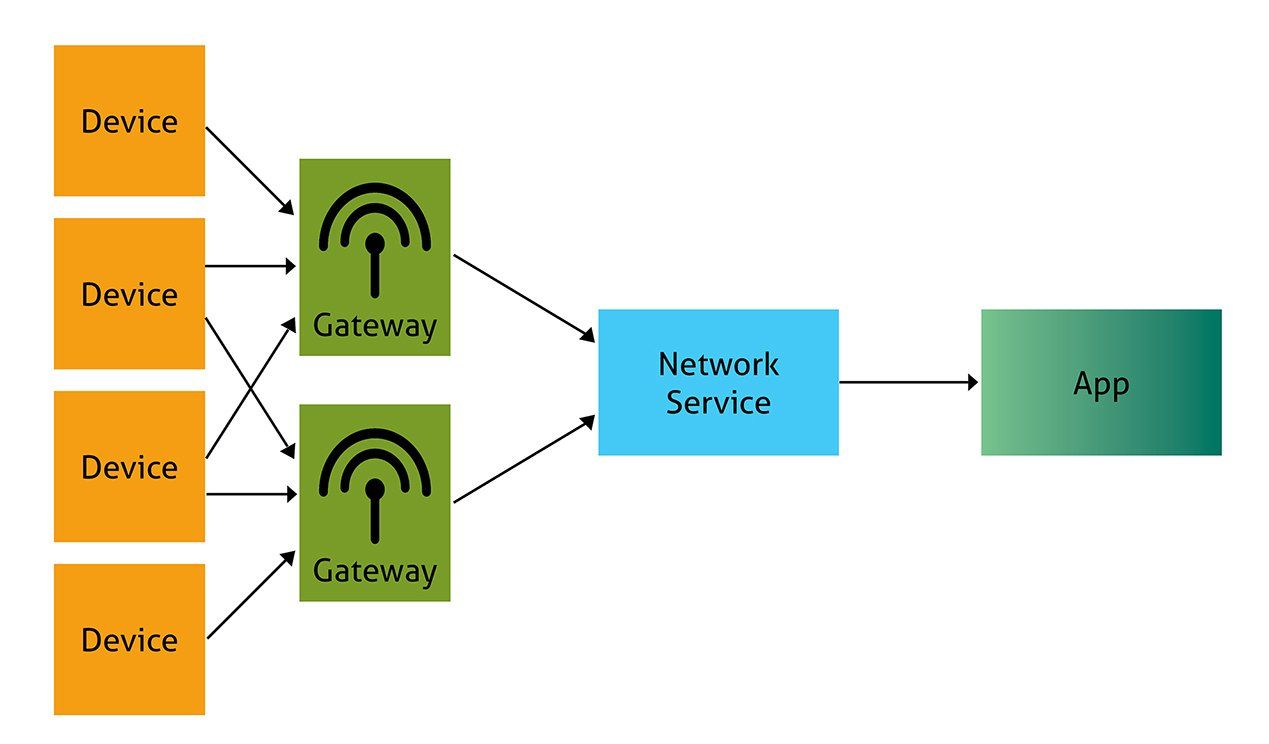
LPWAN networks employ star topology. Multiple gateways listen for device data, which travels to a network service returning responses through the nearest gateway. The network service simultaneously forwards device data to internet-based application servers.
Existing Technologies
Several LPWAN technologies exist: Sigfox, LoRa, and NB-IoT. Technology selection depends on:
- Data transmission requirements
- Device geographic location
- Need for autonomous network/gateway deployment (e.g., remote farms)
- Target costs (devices and data transmission)
- Desired network autonomy (Sigfox offers less openness; LoRaWAN provides greater flexibility)
A detailed overview of LoRa communication technologies is available for download.
Conclusion
LPWAN represents an exciting emerging technology with anticipated infrastructure rollouts expected in 2018 across New Zealand and globally through providers like Spark and Vodafone.
Organizations requiring remote sensors compatible with low data rate applications should seriously consider LPWAN. Beta Solutions possesses development experience with various communications technologies, including LoRaWAN, Sigfox, Cellular, Bluetooth, WiFi, and Satellite communication.
For additional information, subscribe to the blog for forthcoming technical LoRaWAN details, or contact Beta Solutions.