

Introduction
Wireless Sensor Networks (WSNs) represent a rapidly expanding technology enabling better environmental understanding and management across industries including agriculture, manufacturing, and healthcare. A critical design goal involves achieving ultra-low power consumption, allowing devices to operate for years on single batteries.
This article explores key firmware design techniques for maximizing battery longevity in WSN applications.
WSN Topology Overview
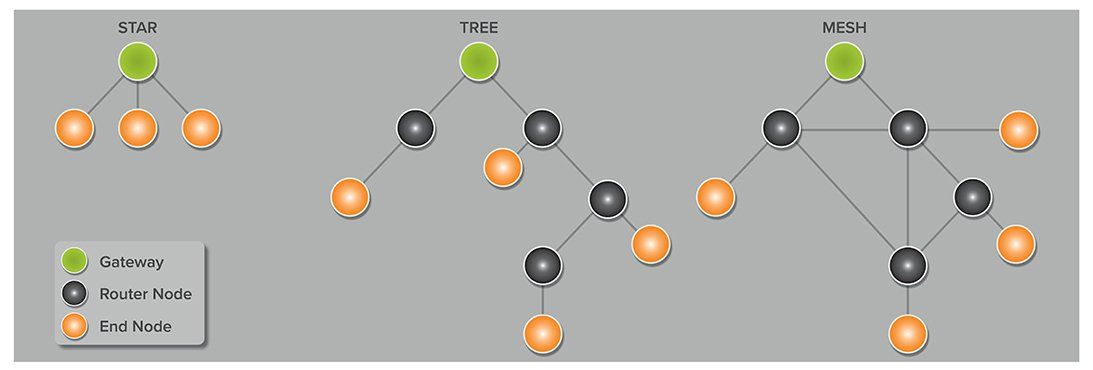
Wireless sensor networks typically comprise three node types:
- Gateway nodes are Internet connection points for the network
- End (sensor) nodes handle data gathering, protocol packaging, and transmission
- Router nodes forward data between sensors and gateway
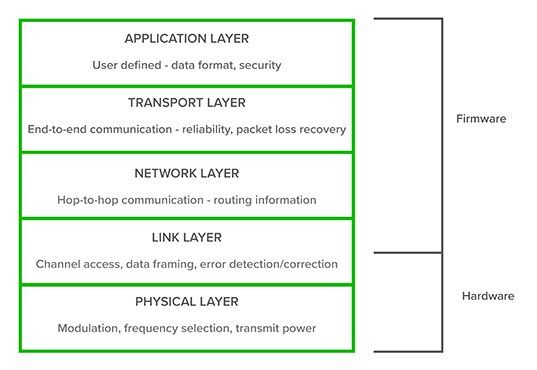
WSN communication occurs across multiple layers, with firmware techniques primarily applying to link layer and higher protocols.
Low Power Firmware Design Techniques
1. Sleep and Wake-up
Since wireless transceivers consume significant power when continuously active, disabling them during idle periods proves essential. Three approaches exist:
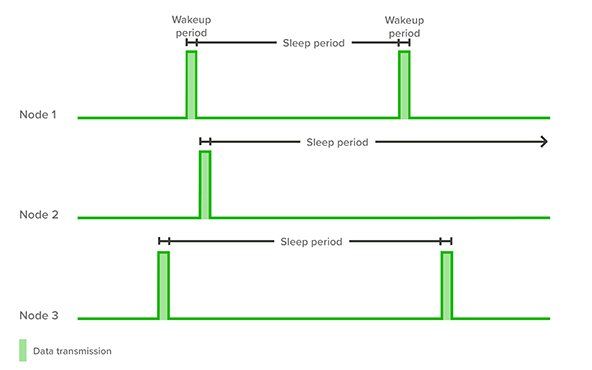
1.a) Synchronous Wake-up (Scheduled Rendezvous)
Nodes duty cycle based on scheduled intervals, for example, activating transceivers for two minutes hourly.
Challenges:
- Balancing power consumption against timely data transmission needs
- Wasting energy during unnecessary wake-ups
- Managing clock drift between synchronized nodes
- Preventing packet collisions during shared wake periods
- Inefficiently waking all nodes when few require communication
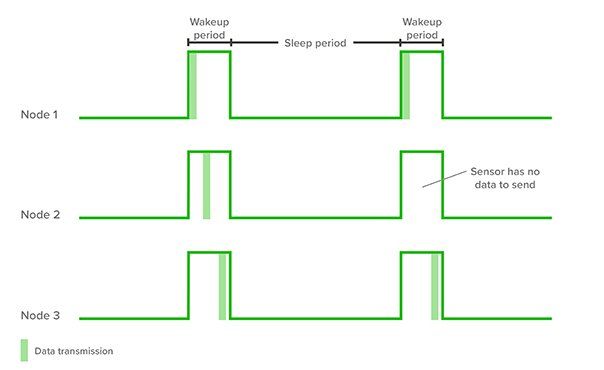
Suitable for: Regular monitoring where real-time delivery isn't critical (ambient temperature logging).
1.b) Asynchronous Wake-up
Nodes wake at independent times, though sender and receiver wake-up periods must overlap for successful transmission.
Advantages over Synchronous:
- Shortened intervals for nodes without pending data
- Eliminates strict time synchronization requirements
Limitations:
- Unsuitable for broadcast traffic
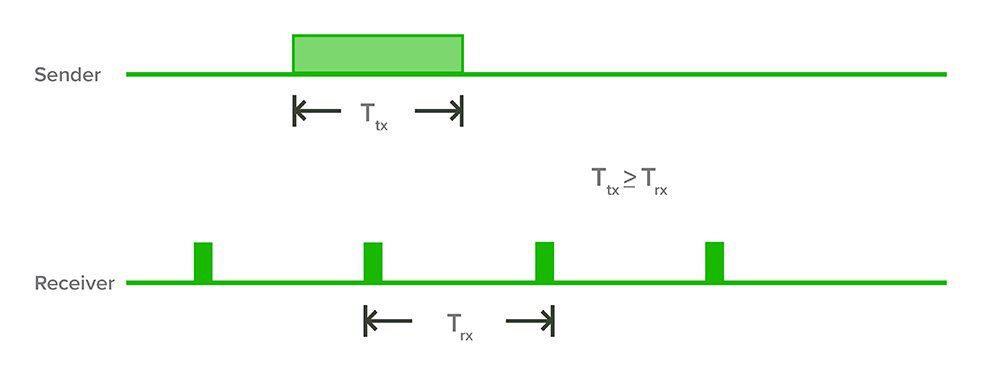
Suitable for: Health monitoring where different sensors require different sampling rates.
1.c) On-Demand Wake-up
Transceivers activate only when communication becomes necessary.
Advantages:
- Minimal transmission latency across the network
Disadvantages:
- Requires a dedicated receiver radio continuously listening for wake-up requests, consuming its own power
- Additional hardware costs may negate energy savings
Suitable for: Event-based monitoring requiring real-time delivery (surveillance systems, forest-fire detection).
2. Transmission Power Control
Wireless networks consume maximum energy during transmission. Ineffectively calibrated power levels waste battery life and create unnecessary interference for unintended receivers.
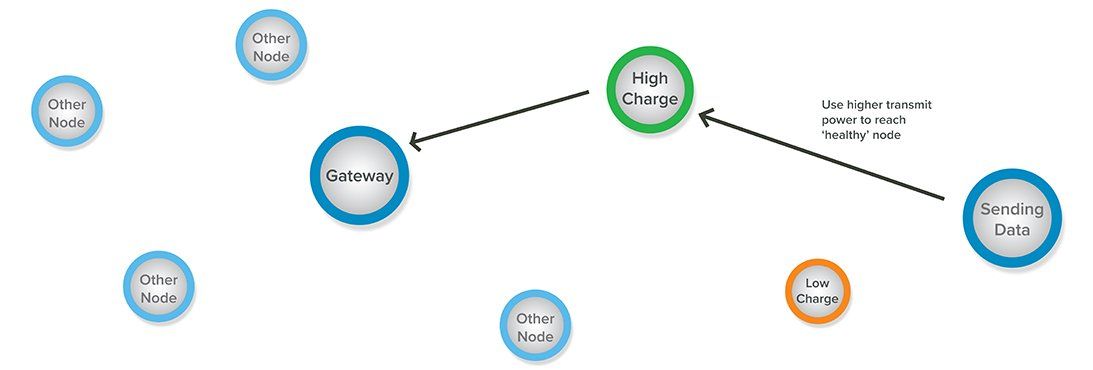
Transmission Power Control techniques use RSSI (received signal strength indicator) to optimize transmitter output, sometimes adapting dynamically to accommodate environmental changes.
This technique enables topology control, deliberately shaping data paths by adjusting transmission power to favor nodes with higher remaining battery levels, ensuring fair workload distribution.
Critical consideration: "The WSN lifetime is often only as good as the lifetime of the first node to fail!"
Suitable for: All WSN deployments; topology control particularly valuable in large mesh networks (agriculture, warehouse inventory).
3. Data Reduction
Since transmitter on-time significantly impacts power consumption, transmitting data efficiently becomes paramount.
3.a) Data Aggregation
Combining multiple readings into single transmissions reduces communication overhead. Sending 24 daily readings once proves more efficient than transmitting individual readings 24 times daily.
Limitation: Incompatible with real-time requirements (though triggered events can transmit stored data).
3.b) Compression/Coding
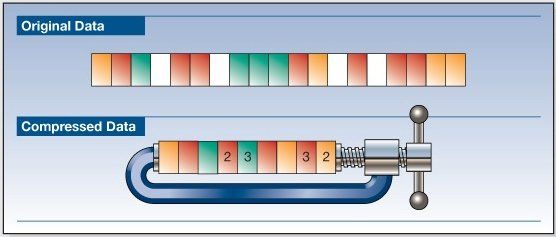
Raw sensor data often contains unnecessary information. Compression reduces required bits, thereby lowering transmission energy.
Lossy compression sacrifices recoverable detail but achieves greater compression, acceptable when approximations suffice. Lossless compression preserves original data exactly.
Quantization example:
- 16-bit temperature resolution (0-99°C) provides 0.0015° theoretical resolution, likely excessive
- 8-bit resolution provides 0.39° resolution, typically sufficient while reducing transmission energy
Other approaches (Fourier transforms, Huffman coding) exploit real-world data patterns for additional compression.
Suitable for: Quantization works across most applications due to low computational demands; advanced techniques suit high-rate sensors (audio, ECG monitoring).
3.c) Adaptive Sampling
Adjusting sampling frequency based on conditions reduces transmission frequency. Example: river monitoring devices transmitting several times daily during normal flow versus multiple times hourly during flooding.
4. Routing Protocol / Clustering
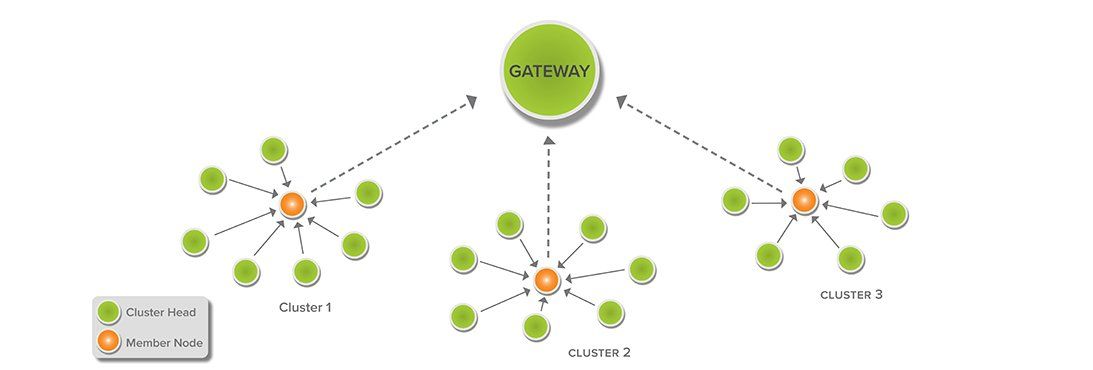
Large WSNs benefit from clustering, organizing nodes into groups with designated cluster-heads forwarding data toward gateways. This enables shorter transmission hops, reducing required power.
Since cluster-heads consume disproportionate energy relaying data, dynamic rotation to higher-battery-level nodes maximizes overall network lifespan.
Suitable for: Large distributed mesh networks (agriculture, warehouse inventory).
Additional Firmware Considerations
Beyond these techniques, designers should evaluate:
- Microcontroller sleep modes for significant power reduction
- Lower clock rates when appropriate
- Powering down unused hardware peripherals
Conclusion
No universal solution exists for WSN power optimization. Effective approaches depend entirely on specific application requirements, demanding careful consideration of competing priorities between power efficiency, latency, and reliability.