Bluetooth Technology - A Quick Recap
Bluetooth is a short-range wireless communication technology operating at 2.4GHz to 2.48GHz frequency, the same band as Wi-Fi. However, Bluetooth transmits weaker signals intended for reduced power consumption and longer battery life.
The technology has evolved significantly:
- Versions 1-3 ("Bluetooth Classic"): Point-to-point (1:1) topology for device pairing
- Version 4 ("Low Energy"), introduced 2010: Point-to-many (1:M) topology enabling beacons to broadcast to multiple receiver nodes
- Version 5 ("Mesh"), introduced 2016: Many-to-many (M:M) topology for large device networks
- Version 5.1: Further advancement introducing direction-finding capabilities
Bluetooth 5.1
The Bluetooth Special Interest Group announced in January 2019 that version 5.1 would include "direction finding" technology. This advancement calculates "the angle of transmission of the Bluetooth device to accurately pinpoint its location." The technology is three times more accurate than RSSI methods.
Two direction-finding methods exist:
Angle of Arrival (AoA)
- Requires antenna array on the receiver end (minimum two antennas; more enable greater precision)
- Transmitter emits a "Constant Tone Extension" packet received by multiple antennas
- Phase delay between antennas determines the angle of arrival
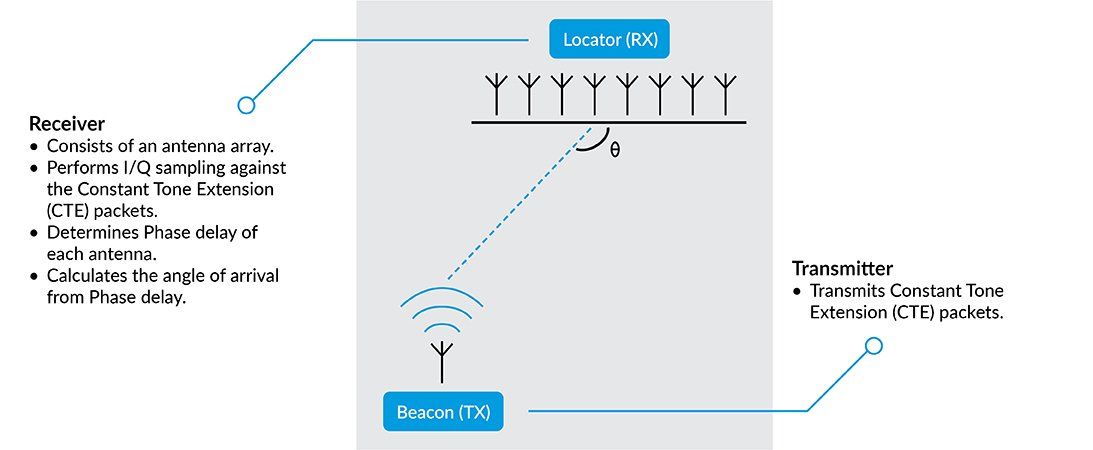
Figure 1. Angle of Arrival (AoA)
Angle of Departure (AoD)
- Antenna array located on transmission end
- Each antenna transmits a Constant Tone Extension packet sampled by single receiver antenna
- Samples enable angle of transmission calculation
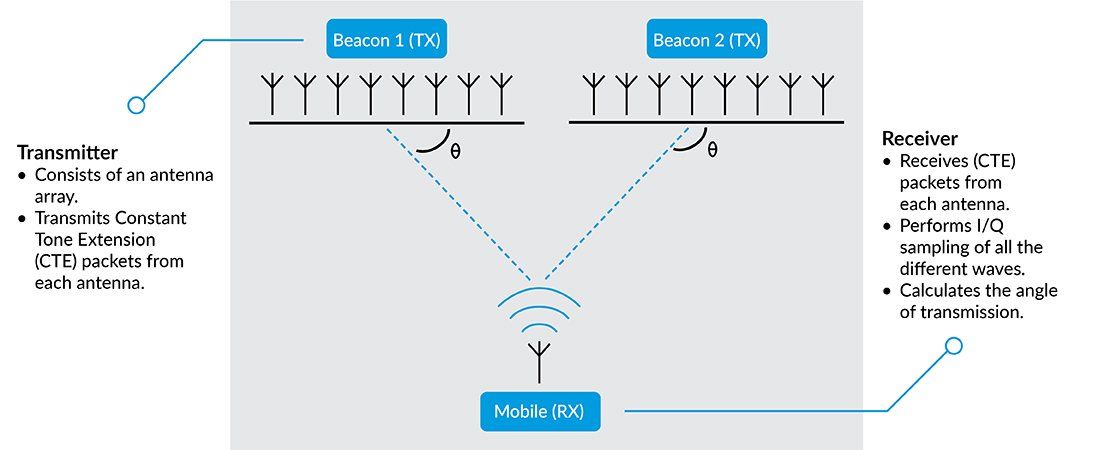
Figure 2. Angle of Departure (AoD)
Important note: Version 5.1 provides direction information only, not position. Distance and position must be deduced using existing received signal strength methods.
Bluetooth 5.1 Applications
Smart Buildings
Bluetooth 5.1 enables wayfinding and asset management in airports, offices, hospitals, and museums.
Wayfinding in Buildings: Phones, tablets, and PCs connect to strategically placed Bluetooth nodes providing accurate pathfinding functionality.

Figure 3. Wayfinding in Buildings
Asset Management in Offices: Large facilities equipped with numerous assets can continuously monitor location via embedded Bluetooth tags, improving efficiency.

Figure 4. Asset Management in Offices
Smart Homes
Home automation products like portable speakers, smart locks, and switches provide security and reduced power consumption.
Personal Property Tags: Direction-finding functionality enables tracking household items. Bluetooth-enabled nodes placed throughout homes eliminate lengthy searches for keys and valued belongings.

Figure 5. Personal Property Tags
Smart Industry
The industrial IoT revolution has enabled manufacturers to increase productivity and reduce operational costs.
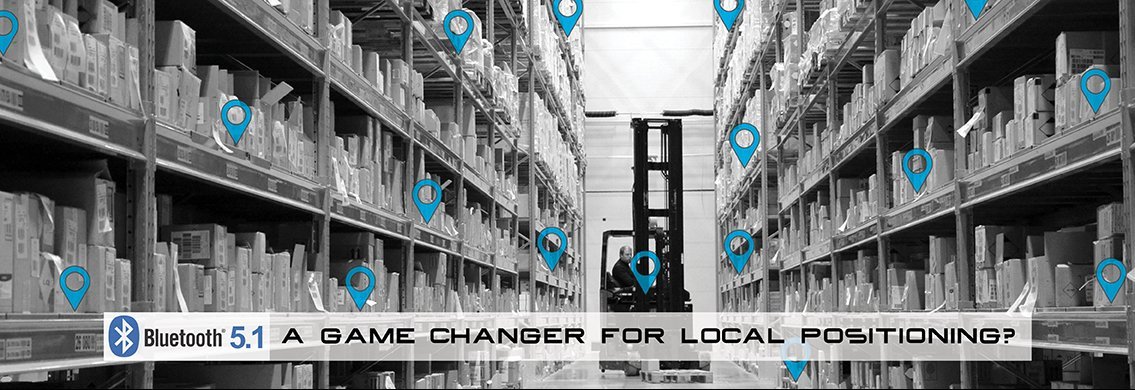
Asset Tracking: Warehouses with thousands of moving assets benefit from Bluetooth 5.1's accurate direction-finding capability. Embedded Bluetooth tags communicate asset details while enabling real-time location monitoring.

Figure 6. Asset Tracing in Warehouses
Conclusion
Bluetooth 5.1's direction-finding capabilities significantly improve indoor positioning resolution compared to traditional RSSI triangulation. Beta Solutions offers expertise in developing Bluetooth 5.1 technology and welcomes inquiries about implementation or hardware/firmware design guidance.