This article represents Part 2 of a two-part series examining critical factors for Internet of Things implementations.
Introduction
IoT solutions span multiple technical disciplines including embedded electronics, communications protocols, cloud infrastructure, and software architecture. Successfully deploying an IoT system requires expertise across four primary domains: Devices, Communications, Cloud/Server infrastructure, and Applications.
11. Power & Battery Life
Power management represents a fundamental challenge in IoT design. Most devices rely on battery power and must operate for extended periods, often years, without replacement. The selection process requires careful evaluation of battery chemistry to minimize self-discharge issues. Three primary power sources exist: mains electricity, solar energy, and battery power. The deployment environment determines which option applies, influencing all subsequent engineering decisions.
12. Communications
Communication protocols present interconnected trade-offs between three factors:
- Range
- Bandwidth
- Power consumption
Different technologies serve different purposes. Some connect directly to the internet, while others require intermediary hubs or gateways. Selecting an appropriate protocol depends on the specific application requirements.
13. Transmission Rate & Quality of Service
Protocols operating on free radio spectrum face "fair use" restrictions limiting transmission frequency. As a result, "LoRa or Sigfox is limited to at most a handful of small bursts of data every few minutes." This constraint suits periodic sensor readings but proves inadequate for critical applications requiring frequent monitoring.
Quality of Service (QoS) considerations matter significantly. Low-power devices typically cannot receive acknowledgment messages after each transmission, meaning data delivery remains uncertain. Applications demanding guaranteed message delivery require protocols offering higher QoS guarantees.
14. Two-way Communications
Bidirectional communication introduces complexity. Low-power devices minimize energy consumption through sleep cycles, creating narrow windows for receiving commands. Devices typically wake, take measurements, transmit data, then listen briefly before returning to sleep. Engineering responsive control systems for low-power devices presents substantial technical challenges.
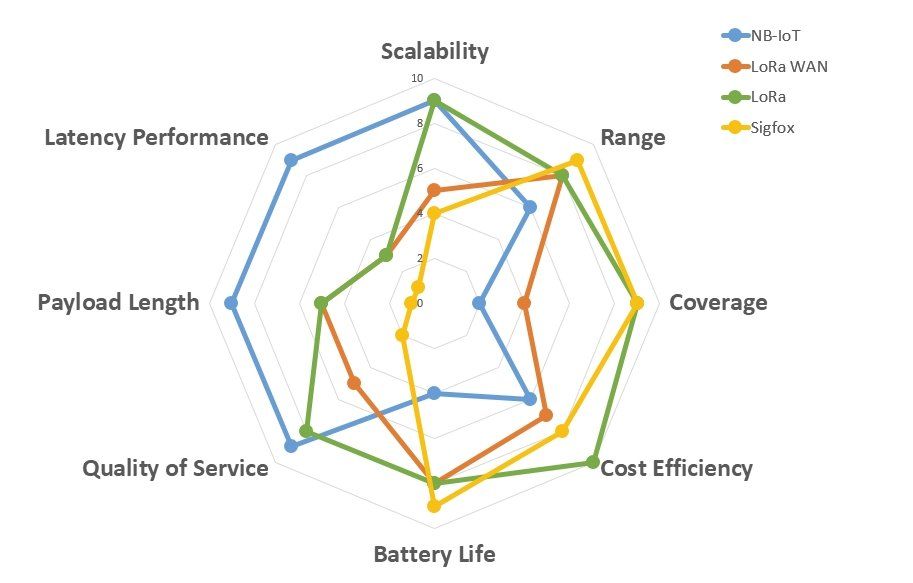
Figure 1: Communications Networks Comparison spider graph as of July 2018
15. Network Selection & Availability
Communication networks lack universal coverage. Cellular providers typically achieve strong urban coverage while rural areas remain spotty. Emerging technologies like LoRa WAN, NB-IoT, and SigFox will likely follow similar deployment patterns. Self-deployed networks like Wi-Fi and LoRa offer flexibility but require ongoing maintenance responsibilities.
16. Remote Updates
Firmware quality must be production-ready before deployment. Limited downstream capabilities in low-power networks currently prevent remote firmware updates. Addressing bugs, applying security patches, and adding features becomes problematic once devices are installed. Higher-power communications protocols enable remote update capabilities.
17. Data Storage Policy & Quantity
IoT deployments generate substantial data volumes. A single sensor recording readings every ten minutes produces approximately 2.5 MB annually. Scaling to 1,000 sensors creates 2.5 GB of annual growth, requiring strategic planning.
Data retention policies warrant careful consideration. Organizations should evaluate whether raw data justifies long-term storage or whether deletion after specified periods reduces storage burden. Cloud infrastructure provides scalability for managing large datasets effectively.
18. Data Quality, Accuracy, Integrity
Data quality requires deliberate engineering rather than chance occurrence. Applications measuring consumable resources demand accuracy sufficient for billing purposes. Sensors may occasionally malfunction. Environmental interference like spider webs in measurement sensors can introduce anomalies. Accuracy requirements vary by application; some need centimeter-level precision while others require millimeter-level accuracy.
19. Edge vs Cloud Compute
Computation can occur on devices or in cloud infrastructure, each approach presenting distinct advantages and limitations.
Cloud processing benefits:
- Simplified software updates
- Centralized data management
- Straightforward implementation
Cloud processing drawbacks:
- No offline functionality during network outages
- Increased data transfer costs
- Higher cloud compute expenses
Edge processing benefits:
- Resilience to internet interruptions
- Self-managing devices
- Minimal additional costs
Edge processing drawbacks:
- Incompatibility with severe battery conservation requirements
- Limited computing resources
Practical implementations typically employ hybrid approaches, performing basic processing on devices while delegating complex computations to remote data centers.
20. Sensors
Sensors represent the foundational component enabling IoT systems. Capturing meaningful data from harsh real-world environments demands specialized expertise and robust design. Multiple sensor types may measure identical phenomena, each offering distinct advantages and limitations. Quality sensing represents one of IoT's most challenging aspects, making consultation with sensing specialists essential for successful deployments.
References
- Photographic images retrieved from https://www.pexels.com